Johnny Rico
A hesitant high school graduate becomes a Mobile Infantry commissioned officer, battling the Arachnid threat for humanity.

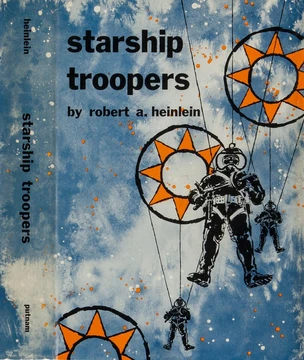
Juan 'Johnny' Rico narrates Robert A. Heinlein's 1959 novel *Starship Troopers* as its first-person protagonist. This Filipino-American teenager joins the Terran Federation's Mobile Infantry straight out of high school, chasing his classmate Carmen Ibañez into the ranks. Set against an interstellar war between humans and the Arachnids, or 'Bugs,' Rico climbs from recruit to officer through brutal training, combat raids, and intense classroom debates on citizenship and civic virtue. His arc tracks a society where only Federal Service veterans earn the right to vote.
- Role
- Mobile Infantry Soldier / Officer
- Affiliation
- Terran Federation
- Rank Progression
- Recruit to Officer
Verified Timeline
Lore & Background
Rico's military career begins with assignment to the Mobile Infantry and training at Camp Arthur Currie on the Canadian prairie under Sergeant Charles Zim. The training is extremely demanding. Early in the novel, Rico serves aboard the corvette transport *Rodger Young* with the platoon 'Rasczak's Roughnecks,' participating in a raid against a planetary colony held by Skinnies. The narrative flashes back to Rico's high school graduation, where his best friend Carl has already enlisted and is on track to become a psychic officer. Rico's parents take his choice poorly, and he leaves with a sense of estrangement. He progresses from recruit to officer over the course of the story, with his experiences in training and combat shaping his understanding of the Federation's values. Later, during the raid on Klendathu, a fellow soldier, Dizzy Flores, is killed in action when a Bug attack destroys the transport she is aboard.
In Their Own Story
The novel opens with Rico aboard the *Rodger Young* as part of Rasczak's Roughnecks, carrying out a raid on a Skinny-held colony. The platoon lands, destroys its targets, and retreats, suffering two casualties. Rico rescues Dizzy Flores, but Flores dies on the return to orbit. The story then flashes back to Rico's high school graduation. He and his friend Carl consider joining the Federal Service; Rico hesitates partly due to his father's attitude toward the military. He decides to enlist after learning that classmate Carmen Ibañez intends to do the same. Rico is assigned to the Mobile Infantry and trains under Sergeant Zim at Camp Arthur Currie. His training is extremely demanding. At the story's opening, Earth is not yet at war, but war is declared after Rico completes his training. The novel intersperses Rico's combat experiences with flashbacks to his 'History and Moral Philosophy' class, where the teacher discusses the history of the Federation's social structure.
Reader's Guide
Johnny Rico is the sole viewpoint character in Heinlein's novel *Starship Troopers*, narrating his journey from civilian to officer in the Mobile Infantry. His story is told through a non-linear structure, with flashbacks to his training and school lessons woven into present-tense combat sequences. Key events include: his enlistment after high school; training under Sergeant Zim at Camp Arthur Currie; his first raid with Rasczak's Roughnecks aboard the *Rodger Young*; the death of Dizzy Flores; and his eventual promotion to officer. Rico's Filipino ancestry is depicted as inconsequential in the Federation's society, which has abandoned racial and gender-based prejudice. Rico's character arc embodies the novel's central theme: that full citizenship—including the right to vote and hold public office—must be earned through Federal Service, most often military service. His experiences in training and combat, along with the philosophical discussions in his history class, shape his understanding of this system.
Did You Know?
- Rico is of Filipino descent, though his ancestry is depicted as inconsequential in the Federation's society, which has abandoned racial and gender-based prejudice.
- Rico's training takes place at Camp Arthur Currie on the Canadian prairie, named for Sir Arthur Currie who rose through the ranks to command the Canadian Corps in World War I.
- Rico serves aboard the corvette transport *Rodger Young*, named after real-life Medal of Honor recipient Rodger Wilton Young.
- Rico's decision to enlist is partly influenced by his classmate Carmen Ibañez also intending to join the Federal Service.
- The novel's narrative structure intersperses Rico's combat experiences with flashbacks to his 'History and Moral Philosophy' class.
Origins and Authorial Intent
Robert Heinlein crafted Starship Troopers as a rapid-fire response to geopolitical tensions during the late 1950s, specifically reacting to President Dwight Eisenhower's suspension of nuclear testing while the Soviet Union continued its own program. This political frustration, sparked by an advertisement from the National Committee for a Sane Nuclear Policy, drove Heinlein to abandon his work on Stranger in a Strange Land and instead pen this military-focused narrative within mere weeks. Originally intended as a juvenile novel for Scribner's, the manuscript faced rejection, likely due to its controversial ideological stance regarding warfare and governance. This setback prompted Heinlein to sever ties with that publisher and pivot toward adult themes. The story first appeared serially in The Magazine of Fantasy & Science Fiction under the title Starship Soldier before being revised by editor Peter Israel for a mature audience at G. P. Putnam's Sons. Heinlein explicitly utilized the novel as a vehicle to clarify his own military background, gained from five years in the US Navy, and his staunch anti-communist views prevalent during the Cold War era.
Societal Structure and Citizenship
The narrative unfolds seven centuries in the future within a Terran Federation governed by a strict meritocracy where full citizenship is not an inherent right but a privilege earned solely through Federal Service. In this affluent yet disciplined society, only veterans of military service possess the franchise to vote or hold public office, while non-servicers retain basic liberties like free speech and assembly without political power. This unique civic framework serves as the backdrop for Juan 'Johnny' Rico's journey from a young recruit to an officer in the Mobile Infantry. The story interweaves Rico's combat experiences against the alien Arachnids with classroom debates where he and his peers grapple with complex philosophical questions regarding suffrage, juvenile delinquency, and moral virtue. These dialogues function as a vehicle for Heinlein's political philosophy, critiquing the perceived lack of discipline in 1950s American society and advocating for stricter social controls, including corporal punishment, to restore civic order.
Critical Reception and Controversy
Upon its release, Starship Troopers secured the prestigious Hugo Award for Best Novel in 1960, lauded by many critics for its vivid depiction of military training and futuristic combat scenarios. However, the book simultaneously ignited intense controversy due to its apparent glorification of militarism and authoritarian governance. Detractors frequently labeled the work as fascist propaganda or a recruitment tool, pointing to the prerequisite of military service for voting rights as evidence of an oppressive political system. While some argued Heinlein was merely exploring hypothetical limitations on suffrage, others condemned the novel's depiction of gender roles and its use of dehumanizing language toward alien enemies that mirrored racial epithets. Despite these sharp divisions in critical opinion, the text undeniably established itself as a polarizing cornerstone of science fiction literature, forcing readers to confront uncomfortable questions about democracy, duty, and the nature of war.
Enduring Legacy and Cultural Impact
Starship Troopers stamped the science fiction genre; critic Darko Suvin called it the 'ancestral text' of American military sci-fi. Its reach goes beyond books, pushing powered armor from fiction into real-world exoskeleton research and storylines everywhere. The novel's political angles sparked decades of debate, inspiring works like Joe Haldeman's *The Forever War* as a direct anti-war counter to Heinlein's militaristic view. Adaptations expanded its footprint, especially Paul Verhoeven's 1997 film, which satirized the source material to critique the fascist undertones in the book. The story still anchors debates on the military's role in society and drives creators examining technology, politics, and warfare.
Frequently Asked Questions
Who is Johnny Rico?
Johnny Rico serves as the central protagonist of the Starship Troopers saga, evolving from an aimless civilian into a celebrated hero for the Terran Federation. His narrative primarily follows his transformation through the brutal realities of interstellar warfare against the Arachnid threat.
What rank does Johnny Rico achieve?
Starting his service as a lowly Private in the Mobile Infantry, Rico rises through the ranks due to his combat prowess and leadership skills. By the end of his known journey, he attains the high position of Major General within the Federation's military structure.
Why did Johnny Rico join the Mobile Infantry?
Rico initially enlists with a selfish motivation to escape his past and pursue a romantic relationship with Carmen Ibanez. However, he soon discovers that the harsh demands of war against the Bugs require him to mature far beyond these personal desires.
What is Johnny Rico's role in the Bug War?
As a Mobile Infantry soldier and later an officer, Rico leads critical assaults that turn the tide against the Arachnid forces. He becomes one of the most decorated figures responsible for saving humanity from total annihilation during the conflict.
How does Johnny Rico's story conclude?
Rico remains on active duty as a hardened leader who has fully embraced his responsibility to protect the Federation. His arc ends with him standing as a symbol of resilience and sacrifice after surviving the most dangerous campaigns against the Bugs.
More in Characters & Personnel
Related in Starship Troopers
Links follow this subject's own source article.